
The Anti-Optimization Method for Exercise
Why Raising the Floor beats Over-Optimization

Everybody Wants To Raise Their Ceiling.
Bigger PRs. Faster miles. The perfect program, the optimal split, the ideal macros, the fanciest recovery toy. People obsess over the top of the mountain while standing in a valley they never climb out of.
Here’s the truth nobody sells you, because you can’t really monetize it: your ceiling doesn’t matter if your floor is on the ground.
The person who trains hard two to three days a week for five years straight will lap the person who runs the “perfect” five to six day program for eight weeks and then vanishes for a month every time life throws a punch. It’s not close. It’s not even the same race.
I’ll save the rest of my rants and for what it’s worth, I do think the pendulum is swinging back the opposite direction somewhat.
But if you are:
Brainwashed by the optimization crowd
In the Huberman cult
Think your workout is ruined/ineffective if you don’t have 45 + minutes
Only workout when the conditions are just right
Constantly falling short of hitting all your workouts weekly
Programming hoping bc you haven’t seen results in 2 weeks
Then this is for you.
Science That Supports
Now let be clear these tables are generalizations of the data out there. I created them in an effort to generalize a lot of research into a concise view. I encourage you to dig deeper on specifics!
The Half-Life of Fitness
This first subject is for the if can’t do it for x amount of time or x times a week why bother crowd?
When you stop training a quality, you don’t lose it all at once, and you don’t lose it evenly (this changes more depending on how advanced you are in certain qualities). My goal showing you this is you realize, “hey it’s not a lost cause”.
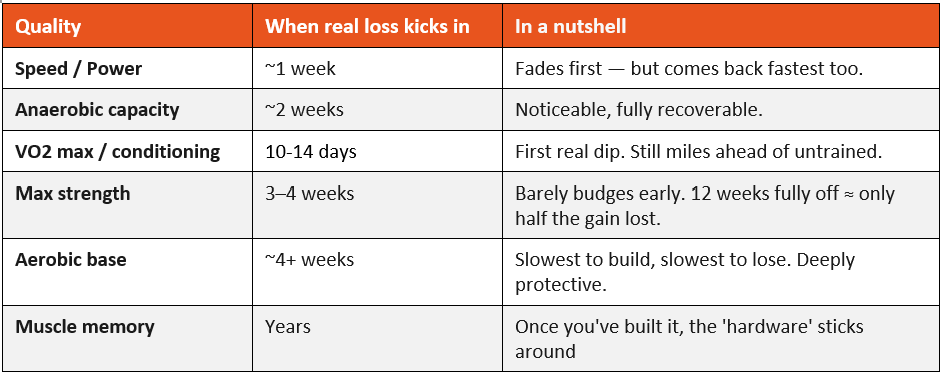
You don't fall from the top floor to the basement. What took months to build takes weeks to start eroding, and even then you keep most of it. Remember HALF LIFE is a representation of how long it takes to fall 50% below your baseline. Another important note, this does not take into account perceived mental levels of difficulty but rather what research has shown as tangible metrics on performance in the given areas.
Minimal Effective Dose (M.E.D)
Here’s the kicker. Maintaining fitness takes a fraction of what it takes to build. You can hold onto nearly everything on one hard session a week as long as the intensity stays.
Personally, I have found with myself and many clients that staying close to the M.E.D. and pushing when conditions are right provides way better results than trying to flirt with the higher end of the spectrum with what’s optimal. The thing about optimal conditions is if the rest of your life is not 100% locked in to support this goal, then it doesn’t mean sh*t.
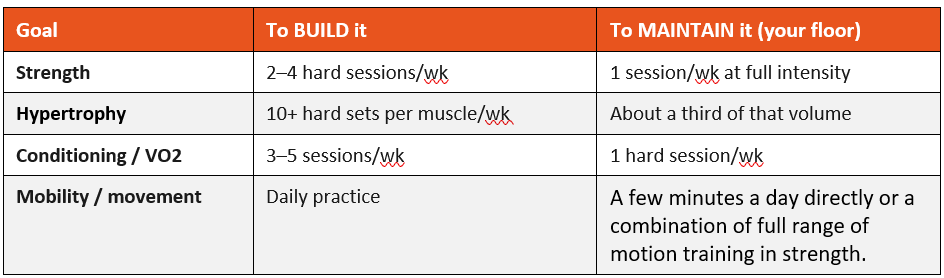
In a nutshell, focus on maintaining. Have a “strike when the irons hot” mentality. Showing up most days and just checking the box is a win. When you feel good or have extra time that’s when you shoot for the level up.
3 ways to actually apply this
Enough theory. Here are three tools for the toolbox that keep your floor rising.
1. Set Your Non-Negotiable Minimum
Pick a floor so small you’d be embarrassed to skip it. Not your ideal day. Your worst case day. A 10-minute walk or jog. One hard set of push-ups to failure. Five minutes of mobility. 5 minutes of kettlebell swings.
The bar is intentionally low. Its only job is to keep you being someone who moves every day. The magic, “I’ll just do the minimum” almost always turns into more once you’ve started. But even on the days it doesn’t… you didn’t hit zero. And zero was the only real enemy.
2. Become a Master Play Caller, Live by the Audible
I have a background in football coaching and playing, as well as being a lifelong fan. So this analogy always hits home for me.
Every good coach has a play script of there first 10+ plays they are going to call. (This is your workouts for the week)
Every great coach is ready to audible out of this the moment things aren’t going as expected. (This is where your workouts live most weeks, if we are being honest)
Two tools I’ve already built for exactly this, so I won’t rehash them here, just go steal them:
● Build your tiers ahead of time. My Good, Better, Best system gives you three pre-set levels of training you can plug into any day. Conceptually you can take this concept and apply it to any day of training or diversify it through multiple avenues in a single day (lifting, sport, cardio, mobility)
● Kill the guesswork in the moment. The Ultimate Guide to Never Miss a Workout Again is a five-question flowchart — how much time, how much energy, what equipment. That provides multiple solutions so you never stall out with decison making.
Between those two, you never have to rely on willpower or invent a workout on the spot. The floor gets automatic.
3. Shrink the Fall-Off
You will fall off. Bad meal, blown weekend, a week where everything goes sideways. That’s not the problem, everybody falls off. The problem is how long you let it ride.
One bad meal isn’t a bad day. One bad day isn’t a bad week. The damage isn’t the fall, it’s the spiral where a skipped Tuesday becomes a written-off month. So stop measuring whether you fell. Start measuring how fast you get back.
Make yourself one promise: the next meal, or the next 24 hours, you’re back on. Not Monday. Not “next month when things settle down.” The very next chance you get. Shrink that gap between bottoming out and climbing back on, and you’ve basically already won.
Don’t just take my word for it though. There’s plenty of other coaches out there providing tools and practical examples of these same concepts.
Kyle Shepard with his month long daily fitness challenges. These can be a GAME CHANGER!
Jordan B. Goldstein was one of the first people to introduce me to the concept of fitness snacks. Along with his approach to connecting your fitness to what you love and your why, it’s not always about getting in the gym.
Benen literally has built his whole newsletter around the 30 minute physique and provides a ton of free workouts. He also is a big practitioner of fitness snacks.
Ronald D. Potts has an awesome 12 week program he came out with recently that’s free and perfect for those who can’t ever get the long term plans to stick.
At the end of day, consistency is king.
Win the Week.
+1
Comprehensive post brother. You nailed it. Haven’t seen the chart before on how long it takes sustain real loss. Love it
I am also a big fan of the NEAT acronym. Some may even say I am a NEAT Freak! Non Exercise Activity Thermogenesis. Just keeping busy and moving such as vacuuming, dusting, cleaning bathrooms, taking the stairs, yard work like gardening, raking leaves, mowing the lawn.